
PIPELINE
Aceso is developing a targeted pipeline designed to address meaningful gaps in cystic fibrosis treatment. Our programs are guided by scientific rigor, patient-centered priorities, and a commitment to translating innovation into therapeutic progress.

01 — Who we are

Bench → bedside
Pipeline
Disease focus
Disease focus
Program
Lead program
Filter by indication
Clinical development stages
| Indication | Project | Mechanism | PoC | Preclinical | Phase 1/2 | Phase 2/3 | Phase 4 | Target year | Status |
|---|---|---|---|---|---|---|---|---|---|
| CF — Class II | ACT-101Lead program | Expression mRNA | Efficacy in 2031 | Ongoing — CTA 2027* | |||||
ACT-201 | Stability CFTR | To define* | PoC done | ||||||
ACT-301 | Bitherapy ACT-101/ACT-201 | To define* | PoC done | ||||||
| CF — Class I | ACT-401 | Splicing defect | n.a | PoC done | |||||
ACT-102 | Non-sense | n.a | PoC done | ||||||
| CPP | WRAP-1 | CF TSB carrier | To define* | PoC done | |||||
| COPD | ACT-105 | Inflammation | n.a | PoC initiated |
Clinical development stages
| Indication | Project | Mechanism | PoC | Preclinical | Phase 1/2 | Phase 2/3 | Phase 4 | Target year | Status |
|---|---|---|---|---|---|---|---|---|---|
| CF — Class II | ACT-101Lead program | Expression mRNA | Efficacy in 2031 | Ongoing — CTA 2027* | |||||
ACT-201 | Stability CFTR | To define* | PoC done | ||||||
ACT-301 | Bitherapy ACT-101/ACT-201 | To define* | PoC done | ||||||
| CF — Class I | ACT-401 | Splicing defect | n.a | PoC done | |||||
ACT-102 | Non-sense | n.a | PoC done |
Clinical development stages
| Indication | Project | Mechanism | PoC | Preclinical | Phase 1/2 | Phase 2/3 | Phase 4 | Target year | Status |
|---|---|---|---|---|---|---|---|---|---|
| CPP | WRAP-1 | CF TSB carrier | To define* | PoC done |
Clinical development stages
| Indication | Project | Mechanism | PoC | Preclinical | Phase 1/2 | Phase 2/3 | Phase 4 | Target year | Status |
|---|---|---|---|---|---|---|---|---|---|
| COPD | ACT-105 | Inflammation | n.a | PoC initiated |
Clinical development stages
| Indication | Project | Mechanism | PoC | Preclinical | Phase 1/2 | Phase 2/3 | Phase 4 | Target year | Status |
|---|---|---|---|---|---|---|---|---|---|
| CF — Class II | ACT-101Lead program | Expression mRNA | Efficacy in 2031 | Ongoing — CTA 2027* | |||||
ACT-201 | Stability CFTR | To define* | PoC done | ||||||
ACT-301 | Bitherapy ACT-101/ACT-201 | To define* | PoC done | ||||||
| CF — Class I | ACT-401 | Splicing defect | n.a | PoC done | |||||
ACT-102 | Non-sense | n.a | PoC done | ||||||
| CPP | WRAP-1 | CF TSB carrier | To define* | PoC done | |||||
| COPD | ACT-105 | Inflammation | n.a | PoC initiated |
Clinical development stages
| Indication | Project | Mechanism | PoC | Preclinical | Phase 1/2 | Phase 2/3 | Phase 4 | Target year | Status |
|---|---|---|---|---|---|---|---|---|---|
| CF — Class II | ACT-101Lead program | Expression mRNA | Efficacy in 2031 | Ongoing — CTA 2027* | |||||
ACT-201 | Stability CFTR | To define* | PoC done | ||||||
ACT-301 | Bitherapy ACT-101/ACT-201 | To define* | PoC done | ||||||
| CF — Class I | ACT-401 | Splicing defect | n.a | PoC done | |||||
ACT-102 | Non-sense | n.a | PoC done |
Clinical development stages
| Indication | Project | Mechanism | PoC | Preclinical | Phase 1/2 | Phase 2/3 | Phase 4 | Target year | Status |
|---|---|---|---|---|---|---|---|---|---|
| CF — Class I | ACT-102 | Non-sense | n.a | PoC initiated | |||||
ACT-401 | Splicing defect | n.a | PoC done |
Clinical development stages
| Indication | Project | Mechanism | PoC | Preclinical | Phase 1/2 | Phase 2/3 | Phase 4 | Target year | Status |
|---|---|---|---|---|---|---|---|---|---|
| CPP | WRAP-1 | CF TSB carrier | To define* | PoC done |
Legend
Completed / active
In progress
Not yet started
Legend
Completed / active
In progress
In progress
Lead program / Orphan drug
ACT-101, a future inhaled RNA therapy with a patented antisense oligonucleotide (ASO)
A future inhaled ASO therapy with a patented antisense oligonucleotide
A novel upstream strategy targeting mRNA expression to enhance CFTR activity
Building on more than ten years of research academia of Montpellier (CNRS, Inserm, University of Montpellier), dedicated to unravel Cystic Fibrosis disease biology and identifying novel therapeutic opportunities.
Identify therapeutic opportunities through focused disease biology and scientific research.
TRL5
TRL5
ACT-101 – candidate optimization and validation are being conducted in collaboration with the PhyMedExp laboratory in Montpellier, including early efficacy and safety studies.
Evaluate candidate potential through laboratory research, validation, and early safety studies.
Stage – 03 TRL6
Prepare programs for regulatory submission and clinical.
TRL6
Advance ACT-101 into human studies with patient-centred endpoints – target beginning 2028
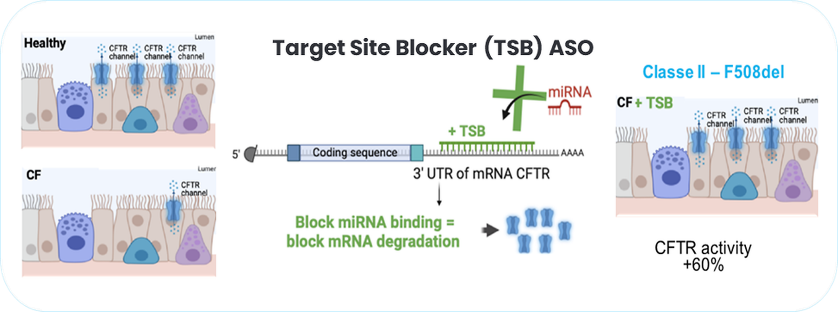
Antisense oligonucleotides (ASOs) are a clinically validated class of medicines that selectively target RNA to modulate gene expression. Several ASO-based therapies are already approved for rare genetic diseases, demonstrating the potential of this technology to address unmet medical needs.
Recent advances in cystic fibrosis (CF) biology have shown that CFTR expression is regulated not only by gene mutations but also by RNA-level mechanisms, including mRNA stability and microRNA-mediated regulation. These discoveries open new therapeutic opportunities aimed at increasing CFTR expression upstream of the protein itself.
ACT-101 is a first-in-class RNA therapeutic based on a patented antisense oligonucleotide (ASO) targeting a novel post-transcriptional regulatory mechanism of the CFTR gene. Unlike current CFTR modulators and emerging therapeutic approaches, ACT-101 acts upstream by masking regulatory microRNA binding sites located within the 3’UTR of CFTR mRNA. This stabilization prevents CFTR mRNA degradation and durably restores endogenous CFTR protein expression without altering the gene sequence. This approach has the potential to address a broad range of CFTR mutations, including those currently ineligible for available therapies.
Preclinical studies performed using the gold-standard air-liquid interface (ALI) model of primary patient-derived bronchial epithelial cells demonstrated restoration of CFTR functional activity of up to 60% across several clinically relevant genotypes, including F508del homozygous and compound heterozygous, I507del, N1303K, and the nonsense mutation Y122X.
By leveraging advances in RNA biology and antisense technologies, ACT-101 has the potential to complement existing CFTR modulators and address the significant unmet needs of patients with incomplete or absent responses to current therapies.
ACT-101 demonstrated efficacy as a monotherapy and an additional functional benefit in combination with the current CFTR modulator tritherapy. In vivo studies confirmed a favorable safety profile and significant CFTR mRNA target engagement, de-risking the program for regulatory development and the upcoming financing round.
ACT-101 is only the beginning. As the first proof-of-concept of Aceso Therapeutics’ proprietary PTGR platform, it paves the way for a new generation of RNA therapeutics. Join us at this pivotal stage to accelerate ACT-101, unlock the full potential of our platform, and transform the lives of patients with severe unmet medical needs.
PARTNERSHIP-READY. PATIENT-CENTERED.
We welcome conversations with scientific, clinical, and strategic partners who share our commitment to advancing meaningful therapies for people living with cystic fibrosis.